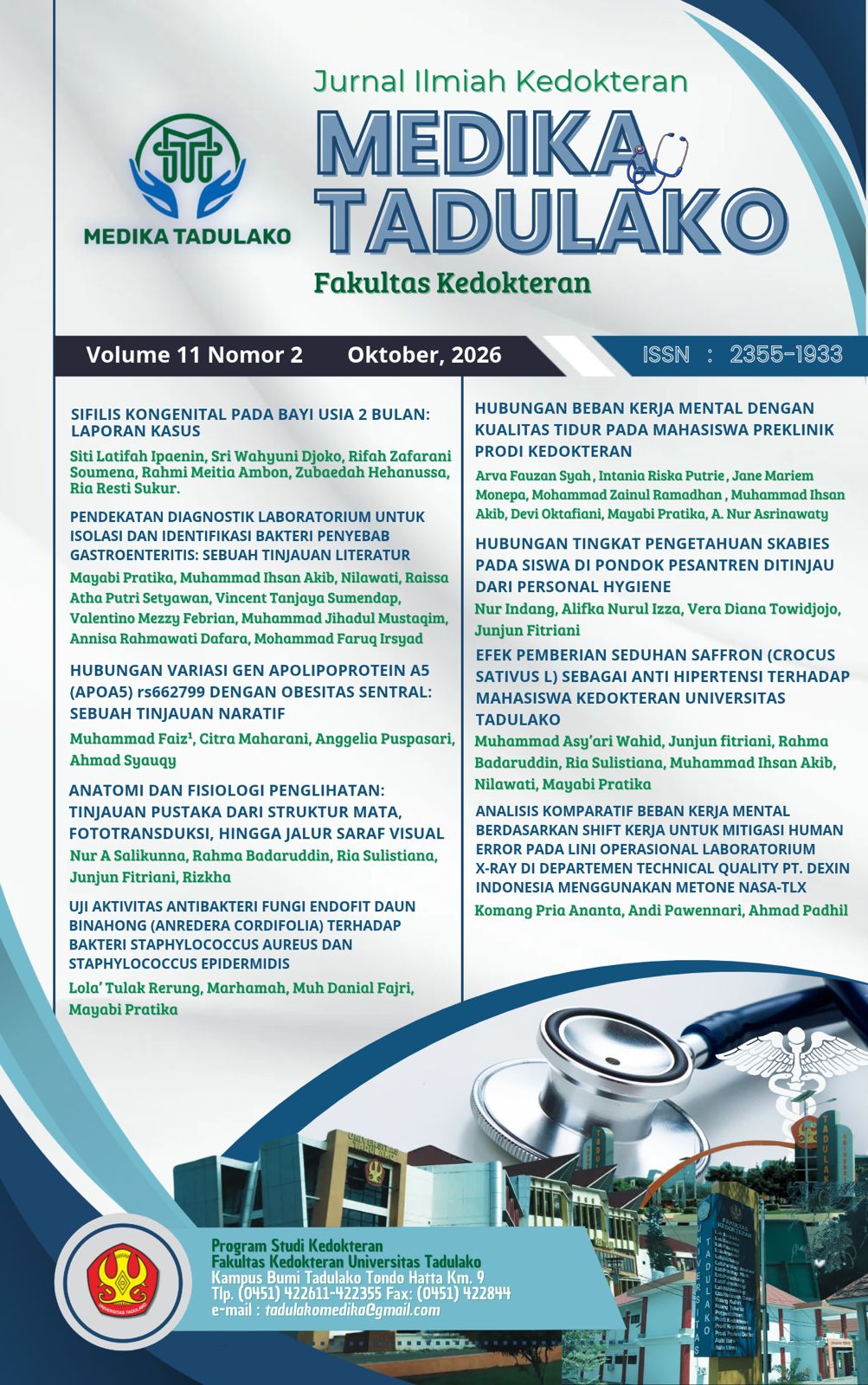
ANALISIS KOMPARATIF BEBAN KERJA MENTAL BERDASARKAN SHIFT KERJA UNTUK MITIGASI HUMAN ERROR PADA LINI OPERASIONAL LABORATORIUM X-RAY DI DEPARTEMEN TECHNICAL QUALITY PT. DEXIN INDONESIA MENGGUNAKAN METONE NASA-TLX
DOI:
https://doi.org/10.22487/6ffrbw11Keywords:
Occupational health, Mental Workload, Occupational psychology, Human Error, ErgonomicsAbstract
This study aimed to analyze and compare the mental workload of operators based on work shifts at the X-Ray Laboratory of the Technical Quality Department of PT. Dexin Steel Indonesia as an effort to mitigate human error. The study employed a quantitative comparative design involving twelve operators selected using total sampling. Data were collected through observation, interviews, documentation, and the National Aeronautics and Space Administration Task Load Index questionnaire. Data analysis included weighting, rating, Weighted Workload calculation, and comparative analysis between work shifts to identify differences in mental workload levels and the most dominant workload dimensions. The results indicated that operators in both work shifts experienced high to very high levels of mental workload, with differences in workload intensity between shifts. The most influential dimensions were mental demand, temporal demand, performance, and frustration level. These findings provide a basis for recommending improvements in work systems, shift scheduling, and mental workload management to reduce the risk of human error while improving operator safety and performance.