
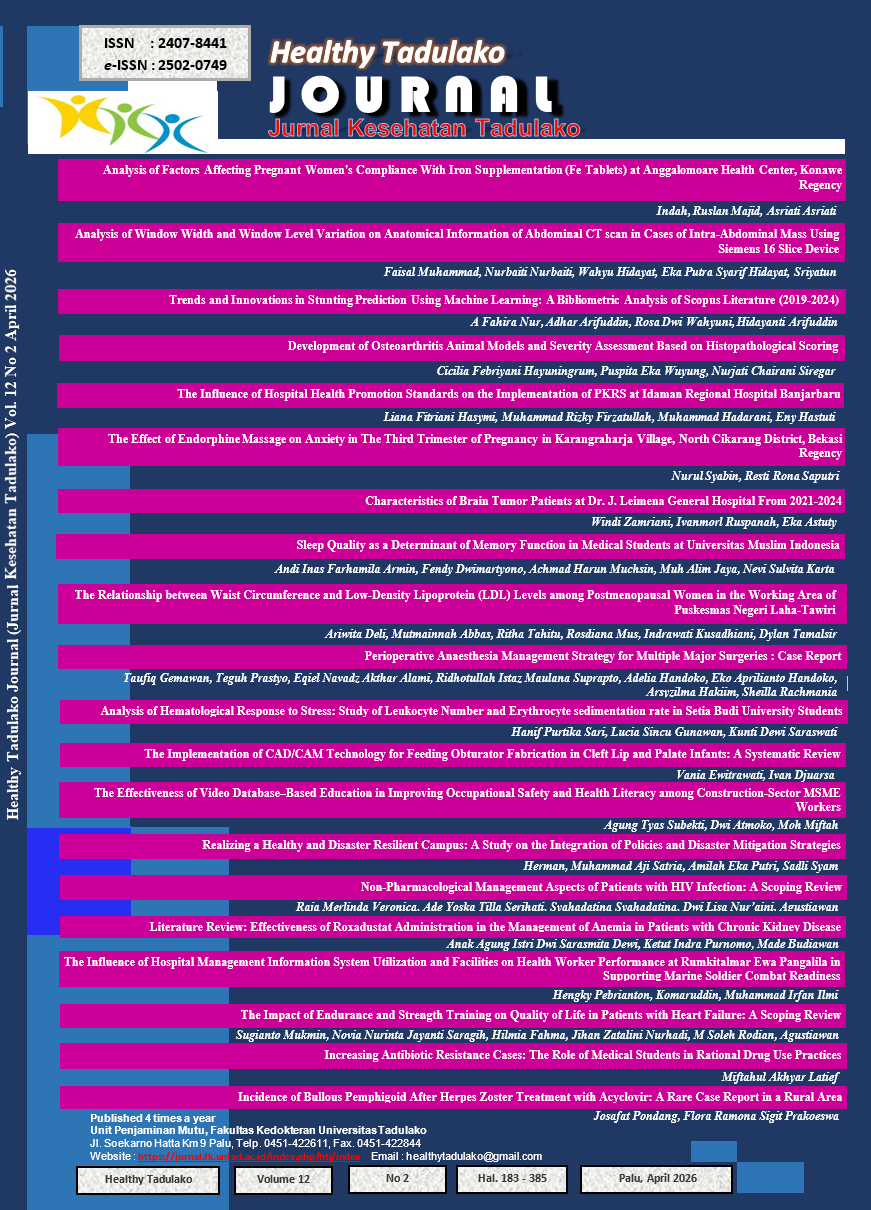
The Impact of Endurance and Strength Training on Quality of Life in Patients with Heart Failure: A Scoping Review
DOI:
https://doi.org/10.22487/ydyjar44Keywords:
Heart Failure, Endurance, Strength, Quality of LifeAbstract
Background: Heart failure (HF) is a progressive condition associated with impaired functional capacity and reduced quality of life (QoL). In addition to pharmacological therapy, exercise-based interventions, including endurance and strength training, have been proposed as effective non-pharmacological strategies to improve outcomes. Objectives: This scoping review aimed to map the existing evidence on the impact of endurance and strength training on QoL in patients with HF, identify intervention characteristics, and highlight gaps for future research. Methods: A systematic search was conducted in PubMed, Scopus, Web of Science, Cochrane, and supplementary sources for studies published between January 2015 and September 2025. Eligible studies included randomized controlled trials, secondary analyses, and intervention reviews reporting QoL outcomes. Screening followed PRISMA-ScR guidelines, and data were extracted on study design, sample size, intervention type, and QoL measures. Results: Out of 1,060 identified records, six studies met inclusion criteria. Interventions included aerobic, resistance, and functional training programs. Most studies reported improvements in QoL, although results varied by exercise modality, patient characteristics, and measurement tools. Conclusions: Endurance and strength training appear to be safe and beneficial strategies to enhance QoL in HF patients. Standardization of protocols and long-term studies are needed to optimize clinical application.
Downloads
References
1. McDonagh TA, Metra M, Adamo M, et al. 2023 ESC Guidelines for the diagnosis and treatment of acute and chronic heart failure. Eur Heart J. 2023;42(36):3599-3726. doi:10.1093/eurheartj/ehab368
2. Servey JT, Stephens M. Cardiac Rehabilitation: Improving Function and Reducing Risk. Am Fam Physician. 2016;94(1):37-43.
3. Mensah GA, Roth GA, Fuster V. The global burden of cardiovascular diseases and risk factors: 2020 and beyond. J Am Coll Cardiol.American College of Cardiology Foundation Washington, DC. 2019;74(20):2529-2532.
4. Desai N, Olewinska E, Famulska A, Remuzat C, Francois C, Folkerts K. Heart failure with mildly reduced and preserved ejection fraction: A review of disease burden and remaining unmet medical needs within a new treatment landscape. Heart Fail Rev. 2024;29(3):631-662. doi:10.1007/s10741-024-10385-y
5. Kemenkes RI. Hasil Utama Riset Kesehatan Dasar Tahun 2018. Kementrian Kesehat Republik Indones. Published online 2018.
6. Okoshi MP, Capalbo RV, Romeiro FG, Okoshi K. Cardiac Cachexia: Perspectives for Prevention and Treatment. Arq Bras Cardiol. 2017;108(1):74-80. doi:10.5935/abc.20160142
7. McMahon SR, Ades PA, Thompson PD. The role of cardiac rehabilitation in patients with heart disease. Trends Cardiovasc Med. 2017;27(6):420-425. doi:10.1016/j.tcm.2017.02.005
8. Gevaert AB, Kataria R, Zannad F, et al. Heart failure with preserved ejection fraction: recent concepts in diagnosis, mechanisms and management. Heart. 2022;108(17):1342 LP - 1350. doi:10.1136/heartjnl-2021-319605
9. Badaruddin R, Fudail M, Fitriana Y, Ramadhan MZ. Pengaruh Latihan Tes Cooper Terhadap Indeks Massa Tubuh pada Mahasiswa Obesitas Fakultas Kedokteran Universitas Tadulako. Heal Tadulako J (Jurnal Kesehat Tadulako). 2024;10(3 SE-):361-369. doi:10.22487/htj.v10i3.1208
10. Sumarni S, Sari P. Surveilans Petanda Kardiometabolik pada Sivitas Akademika Universitas Tadulako. Heal Tadulako J (Jurnal Kesehat Tadulako). 2020;4(1 SE-):15-21. doi:10.22487/htj.v4i1.58
11. Eleyan L, Gonnah AR, Farhad I, et al. Exercise training in heart failure: current evidence and future directions. J Clin Med. 2025;14(2):359.
12. Akyuz A. Exercise and Coronary Heart Disease. Adv Exp Med Biol. 2020;1228:169-179. doi:10.1007/978-981-15-1792-1_11
13. Fisher S, Smart NA, Pearson MJ. Resistance training in heart failure patients: a systematic review and meta-analysis. Heart Fail Rev. 2022;27(5):1665-1682. doi:10.1007/s10741-021-10169-8
14. Edelmann F, Wachter R, Duvinage A, et al. Combined endurance and resistance exercise training in heart failure with preserved ejection fraction: a randomized controlled trial. Nat Med. 2025;31(1):306-314.
15. Souza WMM de, Vieira MC, Nascimento PMC, Serra SM, Reis MS. Strength training improves functional capacity of individuals with chronic heart failure: Randomized clinical trial. J Bodyw Mov Ther. 2024;39:583-589. doi:10.1016/j.jbmt.2024.03.065
16. Brubaker PH, Nicklas BJ, Houston DK, et al. A Randomized, Controlled Trial of Resistance Training Added to Caloric Restriction Plus Aerobic Exercise Training in Obese Heart Failure With Preserved Ejection Fraction. Circ Hear Fail. 2023;16(2):e010161. doi:10.1161/CIRCHEARTFAILURE.122.010161
17. do Nascimento DM, Machado KC, Bock PM, et al. Functional training improves peak oxygen consumption and quality of life of individuals with heart failure: a randomized clinical trial. BMC Cardiovasc Disord. 2023;23(1):381. doi:10.1186/s12872-023-03404-7
18. Pandey A, Segar MW, Singh S, et al. Frailty Status Modifies the Efficacy of Exercise Training Among Patients With Chronic Heart Failure and Reduced Ejection Fraction: An Analysis From the HF-ACTION Trial. Circulation. 2022;146(2):80-90. doi:10.1161/CIRCULATIONAHA.122.059983
19. Alves LS, Bocchi EA, Chizzola PR, et al. Exercise training in heart failure with reduced ejection fraction and permanent atrial fibrillation: A randomized clinical trial. Hear Rhythm. 2022;19(7):1058-1066. doi:10.1016/j.hrthm.2022.03.1217
20. Chen YW, Wang CY, Lai YH, et al. Home-based cardiac rehabilitation improves quality of life, aerobic capacity, and readmission rates in patients with chronic heart failure. Medicine (Baltimore). 2018;97(4):e9629. doi:10.1097/MD.0000000000009629
21. Siddiqi AK, Shahzad M, Kumar A, et al. The efficacy of inspiratory muscle training in improving clinical outcomes in heart failure patients: An updated systematic review and meta-analysis. J Cardiol. Published online 2025.
22. Dieli-Conwright CM, Courneya KS, Demark-Wahnefried W, et al. Effects of aerobic and resistance exercise on metabolic syndrome, sarcopenic obesity, and circulating biomarkers in overweight or obese survivors of breast cancer: {A} randomized controlled trial. J Clin Oncol. 2018;36(9):875-883. doi:10.1200/JCO.2017.75.7526
23. Hellsten Y, Nyberg M. Cardiovascular Adaptations to Exercise Training. Compr Physiol. 2015;6(1):1-32. doi:10.1002/cphy.c140080
24. Liu YT, Deng CJ, Yang FL, et al. Efficacy of different modes of exercise-based cardiac rehabilitation delivery for patients with heart failure: a systematic review and network meta-analysis. Cardiovasc Diagn Ther. 2025;15(3):526-538. doi:10.21037/cdt-2024-698
25. Afriani AB, Ginting SC, Anggita GM. The Effect Of Aerobic Exercise On Body Weight and Body Fat Percentage. In: ISMINA 2021: Proceedings of the 5th International Conference on Sports, Health, and Physical Education, ISMINA 2021, 28-29 April 2021, Semarang, Central Java, Indonesia. Vol 14. European Alliance for Innovation; 2021:194.
26. Slimani M, Ramirez-Campillo R, Paravlic A, Hayes LD, Bragazzi NL, Sellami M. The Effects of Physical Training on Quality of Life, Aerobic Capacity, and Cardiac Function in Older Patients With Heart Failure: A Meta-Analysis. Front Physiol. 2018;9:1564. doi:10.3389/fphys.2018.01564
27. Alamsyah A, Sulasri S, Hasbullah H, et al. Penderita Jantung Koroner (PJK) dengan Gangguan Kebutuhan Oksigenasi. Heal Tadulako J (Jurnal Kesehat Tadulako). 2020;5(3 SE-):38-44. doi:10.22487/htj.v5i3.129
28. Jakovljevic DG. Physical activity and cardiovascular aging: Physiological and molecular insights. Exp Gerontol. 2018;109:67-74. doi:https://doi.org/10.1016/j.exger.2017.05.016
29. Kamiya K, Tanaka S, Saito H, et al. Effects of acute phase intensive exercise training in patients with acute decompensated heart failure. Heart Fail. 2025;13(6):912-922.
30. Wedegärtner SM, Böhm M, Bernhard B, Schwantke I, Kindermann I, Karbach J. Improving cognitive function in patients with heart failure–The Cognitive Training in Heart Failure Study (CogTrain-HF). J Cogn Enhanc. Published online 2025:1-12.
Downloads
Published
Issue
Section
License
Copyright (c) 2026 Sugianto Mukmin, Novia Nurinta Jayanti Saragih, Hilmia Fahma, Jihan Zatalini Nurhadi, M Soleh Rodian, Agustiawan Agustiawan

This work is licensed under a Creative Commons Attribution-ShareAlike 4.0 International License.